
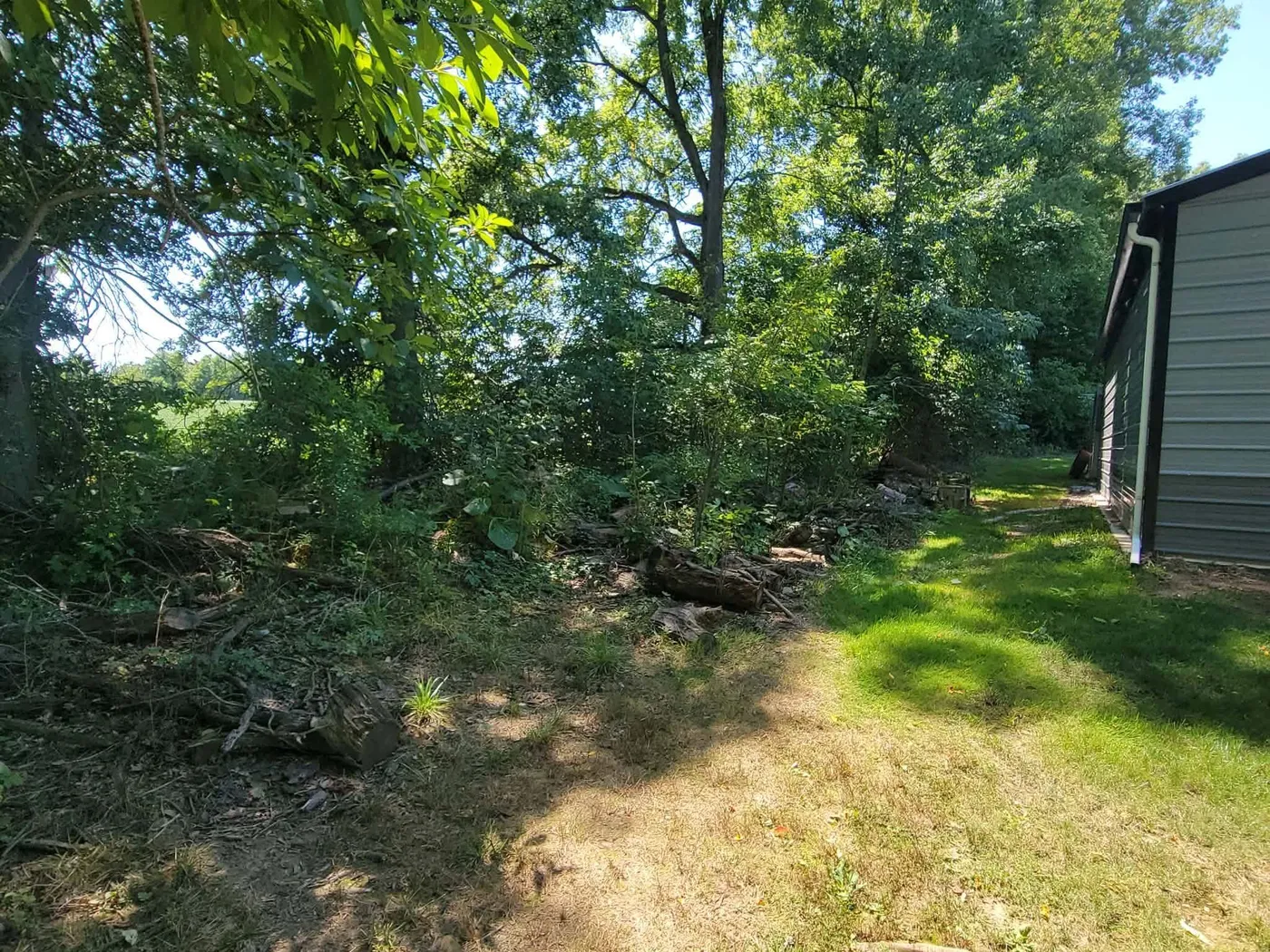
Can an Ohio township make you clear overgrown land and bill you for it?
Yes. Under Ohio Revised Code 505.87, township trustees can find that overgrown vegetation on your land is a nuisance. They can then order you to clear it, with at least seven days’ notice. If the work is not done, the township has it done. The cost goes on the tax duplicate as a lien on the land.
That is the township side of Ohio nuisance property law. Cities and villages work under other sections of state law, with their own deadlines. For overgrown brush, briars and saplings, brush removal with our tracked mulcher grinds the growth into chips where it stands.
This guide explains what the statutes say. It is general information, not legal advice. Your own notice is the document that counts, so read it closely. Call the township or city office that sent it with any question about your deadline or your land.
| Where the land is | Who can order it | Notice | Deadline | Where the cost goes |
|---|---|---|---|---|
| Township, first notice | The board of township trustees, under ORC 505.87 | To the landowner and lienholders, by certified mail or posted on the principal structure and photographed | At least seven days before the township acts | Entered on the tax duplicate as a lien on the land |
| Township, repeat within twelve consecutive months | The same board, for the same land and owner | A repeat notice | At least four days before the township acts | Entered on the tax duplicate as a lien on the land |
| City or village, noxious weeds | The city or village, under ORC 731.51 | Notice served on the property owner | Five days after notice to cut and destroy them | Abatement costs can be certified to the county auditor for the tax list, under ORC 715.261 |
| City or village, litter | The city or village, under ORC 731.51 | Notice served on the property owner | Fifteen days after notice to collect and remove it | Abatement costs can be certified to the county auditor for the tax list, under ORC 715.261 |
What does Ohio Revised Code 505.87 let a township do?
Ohio Revised Code 505.87 covers vegetation, garbage, refuse and other debris on land in a township. It lets the board of township trustees provide for its abatement, control or removal. First the board must determine that the landowner’s maintenance of it is a nuisance. That finding is what starts the process.
In plain words, abatement means the township can have the problem cleared. On an overgrown property, the vegetation part is the brush, briars, saplings, tall weeds and grass. The current version of the law took effect April 3, 2025.
The same section reaches garbage, refuse and other debris. That part is a different job, and it is not ours. Our crew clears vegetation only and hauls nothing off the property.
How much warning does a township nuisance notice give you?
At least seven days. Before the township acts, the board must notify the landowner and any lienholders. The notice goes by certified mail, or it is posted on the principal structure on the land and photographed. If the board finds a repeat nuisance within twelve consecutive months, the notice can come just four days ahead.
The repeat rule covers the same land and the same landowner. Its twelve months run from the prior nuisance determination. Land cleared once under a notice and then left to grow back can face the shorter clock.
Read the notice the day it arrives. Seven days goes fast when work has to be lined up, and four days goes faster.
What happens if the township clears the land for you?
The township has the work done, and the bill follows the land. The board reports its costs to the county auditor. They can include labor, materials and equipment, plus the board’s charges for its services and the cost of notice. The auditor enters them on the tax duplicate, and they become a lien on the land.
The township pays the costs from its general fund. If they run over five hundred dollars, the board may borrow to pay them. Any fees or interest on that borrowing can be part of the report to the auditor.
A lien is a legal claim against the land itself. Ask the township how its bill is figured before the deadline passes.
What can you do once the notice arrives?
Read it closely, then call the township that sent it with your questions. You can do the work yourself or hire it done before the deadline. The statute also allows an agreement. The landowner or a lienholder may enter one with the board of township trustees about who does the work.
Ask the township what it needs to see by the deadline. Ask whether the notice covers the whole parcel or one part of it. Write down who you spoke with and what they said.
Two other Ohio laws can also apply to overgrown land. If the notice names noxious weeds such as poison hemlock, read our guide to poison hemlock in Ohio. It covers the township weed law and when mowing works. Brush in a fence row has its own rules, laid out in our Ohio line fence law guide.
Do cities and villages follow the same rules?
Not the same ones. Cities and villages work under other sections. Ohio Revised Code 731.51 gives a property owner served notice of noxious weeds five days to cut and destroy them. Litter gets fifteen days after notice to be collected and removed. Abatement costs can go on the tax list under Ohio Revised Code 715.261.
Under 715.261, the city or village certifies the costs to the county auditor. The auditor places them on the tax list and duplicate. If the costs are certified within one year from when they were incurred, the lien dates back to that day.
Read your notice for the rule it names, and call the city or village office that sent it. Litter is not our work. Inside town limits, we clear the weeds, brush and saplings.
What does clearing an overgrown property actually take?
It depends on what is growing. Brush, briars and saplings are mulched in place by our tracked machine, so the chips stay where the growth stood. Tall weeds and grass get brush hogged. Nothing is burned or hauled off. The crew clears roughly half an acre to two acres a day, and density sets the pace.
| What the notice may cover | Does our crew clear it? | How it gets handled |
|---|---|---|
| Brush, briars and thickets | Yes | Ground into chips by the tracked mulcher, right where it grew |
| Saplings and trees up to about 6 inches | Yes | Mulched in place, with stumps ground 1 to 2 inches below grade |
| Trees of 6 to 10 inches | Often | Slower, and worked selectively |
| Larger timber | No | Tree-service work |
| Tall weeds and grass | Yes | Cut with the brush hog, a heavy rotary cutter |
| Brush that is already cut and piled | Depends | We do not haul it; whether it can be ground where it lies is decided at the estimate |
| Garbage, refuse, junk, litter and other debris | No | Not our work, and we do not haul; a hauler handles that part |
The tracked mulcher takes brush, briars, saplings and trees up to about 6 inches in diameter. Stems of 6 to 10 inches go slower and are often workable selectively. Stumps are ground 1 to 2 inches below grade, so a mower can ride over them. Topsoil and roots stay in place, so the ground is stable the day the crew leaves.
Tall grass and weeds are brush hogging work, done with a heavy rotary cutter. If the overgrown parcel is a building lot, lot clearing can open the whole site at once.
Garbage, refuse, junk, litter and other debris are not our work, and we do not haul. If your notice covers junk as well as growth, plan on a hauler for that part.
A pile of brush that is already cut is not something we haul either. Whether it can be ground where it lies is decided at the estimate. If you planned to pile and burn the brush instead, read Ohio’s open burning rules first.
What does it cost to clear an overgrown property?
At regional market rates, typical residential mulching jobs land in the low thousands per acre. Light brush costs far less than dense regrowth. We give a free written estimate after an on-site look, and the price and timeline hold unless the scope changes. Ask for it as soon as the notice arrives.
Density and tree size move the price. Trees past about 6 inches go slower, and keeper trees take careful work around them. Our brush removal cost guide covers what moves the number on Ohio ground.
How do you get the work done before the deadline?
Call the office that sent the notice first, and confirm the deadline and what it needs to see. Then call or text us for a free on-site estimate, and tell us the date on your notice. Most residential jobs run one to three days. The timeline comes in writing with the estimate.
The season matters. Late summer through winter is prime clearing season, and frozen or dry ground carries the machine cleanly. Wet spring clay is the one season the crew sometimes steers around, because the tracks can rut it. If your deadline lands in a wet spell, tell the township when you call.
Keeper trees get flagged before the work starts, and the crew works around them. The ground is left as chips over intact topsoil and roots, ready to mow.
When you are ready, we can clear the overgrown brush and saplings off your land. Call or text (614) 359-8762, or ask for a free estimate. We are based in Mansfield and work up to 75 miles out across north central Ohio.